⚡ Quick Answer
What Do Phone Specifications Mean?
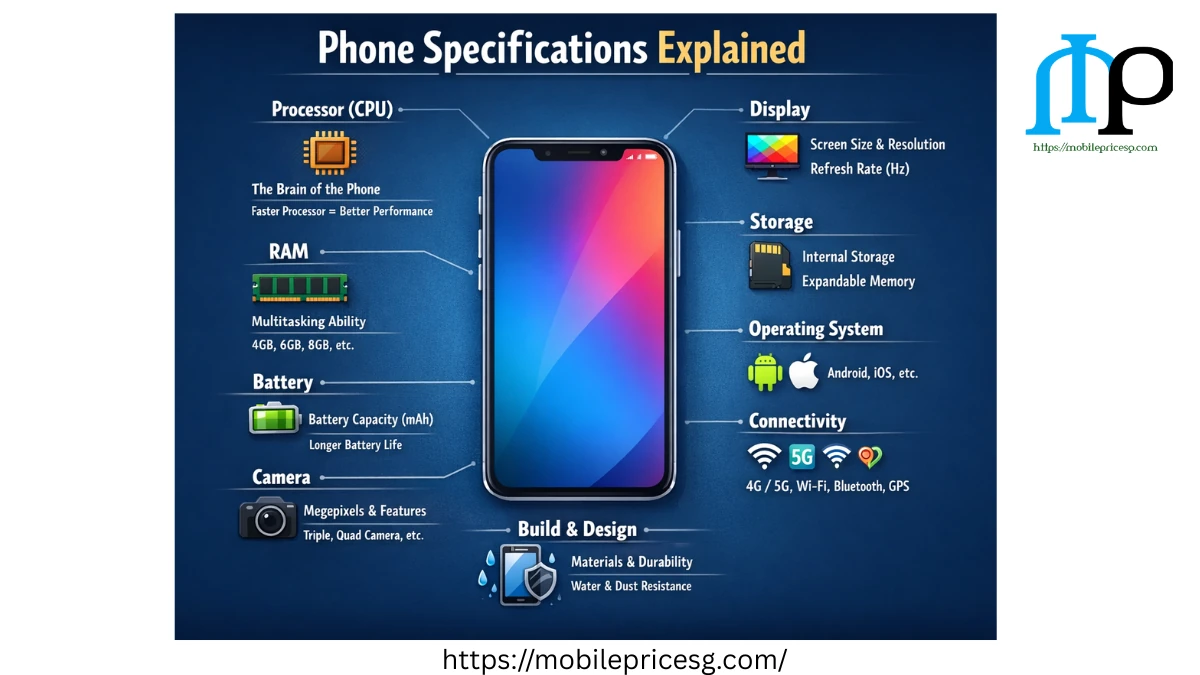
Phone specifications describe a smartphone’s hardware capabilities.
RAM determines multitasking ability,
the processor (chip) controls overall speed,
display type and refresh rate affect how smooth the
screen looks, megapixels describe camera resolution,
mAh measures battery capacity, and
5G/4G describes network speed capability.
This guide explains every major phone specification in plain English
for Singapore buyers in 2026.
Why Understanding Phone Specs Matters
When buying a smartphone in Singapore — whether a budget 5G phone
under S$300 or a flagship costing S$1,700+ — you will encounter
dozens of technical terms in the specifications sheet.
RAM, AMOLED, Snapdragon, mAh, Hz, MP, IP68 —
these terms can be confusing without a clear guide.
Understanding what each specification means allows you to
compare phones accurately, identify what matters for your
usage and avoid paying for features you do not need.
This guide covers every major smartphone specification category —
from processor and RAM to camera and connectivity — explained
simply for everyday Singapore buyers.
📚
How to Use This Guide
Use the Table of Contents in the sidebar to jump directly to the specification category you want to understand. Each section explains what the term means, what numbers are good, and what matters for Singapore daily use in 2026.
Quick Reference — Key Phone Specs at a Glance
🧠
RAM
Short-term memory for running apps
🤖
Processor
The brain — controls all phone speed
💾
Storage (ROM)
Space for apps, photos and files
🖥️
AMOLED/LCD
Display panel technology type
🔄
Refresh Rate (Hz)
How smooth the screen feels
📷
Megapixels (MP)
Camera image resolution
🔋
Battery (mAh)
How long the phone lasts
📶
5G / 4G
Mobile data network speed
💧
IP Rating
Water and dust resistance level
🤖
Processor / Chipset / SoC
System on a Chip — the brain of your phone
Most Important
The processor (also called chipset or SoC — System on a Chip)
is the brain of your smartphone. It controls everything — how fast apps
open, how smoothly games run, how quickly photos process and how efficiently
the phone uses battery power. A more powerful processor means a faster,
smoother phone experience overall.
In Singapore in 2026, the main processors you will see are:
Apple A-series (iPhones),
Qualcomm Snapdragon (most Android flagships),
Samsung Exynos (some Samsung phones),
MediaTek Dimensity (mid-range Android phones) and
Google Tensor (Pixel phones, optimised for AI).
Flagship 2026:Snapdragon 8 Elite / Apple A19 Pro
Mid-range:Snapdragon 7s / Dimensity 8300
Budget:Dimensity 6100+ / Snapdragon 4s
🏎️
CPU Cores & Clock Speed (GHz)
Central Processing Unit — processing power
Performance
CPU cores are like workers inside the processor —
more cores allow more tasks to be handled simultaneously.
Clock speed (GHz) measures how fast each core works.
Most modern smartphones have 8 cores (octa-core)
split between high-performance cores for demanding tasks and
efficiency cores for everyday use to save battery.
Higher GHz = faster individual task processing.
Good clock speed:3.0GHz+ (flagship)
Mid-range:2.4–2.8GHz
🎮
GPU
Graphics Processing Unit — for gaming and video
Gaming
The GPU (Graphics Processing Unit) handles all
visual processing — gaming graphics, video playback, UI animations
and camera processing. A powerful GPU is essential for playing
demanding games like Genshin Impact, PUBG Mobile or
COD Mobile at high graphics settings. In flagship phones,
the GPU is integrated into the main SoC chip.
Best GPUs 2026:Adreno 830 / Apple GPU / Immortalis G925
🇸🇬
Processor Recommendation for Singapore Buyers
For daily use in Singapore (WhatsApp, social media, streaming, maps), a mid-range Snapdragon or Dimensity chip is more than sufficient. For gaming or photography, invest in a Snapdragon 8 Elite device. For the best AI features in Singapore’s multilingual environment, Google’s Tensor G5 (in the Pixel 10) offers unique advantages.
🧠
RAM
Random Access Memory — short-term working memory
Multitasking
RAM (Random Access Memory) is your phone’s
short-term working memory. It stores apps and data that your
phone is currently using — allowing you to switch between apps
quickly without reloading them. More RAM = smoother
multitasking and more apps kept open simultaneously.
Unlike storage, RAM does not keep data when the phone is off.
| RAM Amount |
Best For |
Verdict |
| 4GB RAM |
Basic use only |
Minimum 2026 |
| 6GB RAM |
Light everyday use |
Acceptable |
| 8GB RAM |
Most users — daily use |
✓ Recommended |
| 12GB RAM |
Heavy users + gaming |
✓ Excellent |
| 16GB+ RAM |
Gaming phones + power users |
✓ Premium |
💾
Internal Storage (ROM)
Read-Only Memory / eMMC / UFS — long-term data storage
Space
Internal storage (often labelled ROM) is where
your phone permanently stores everything — apps, photos, videos,
music and documents. Unlike RAM, storage keeps your data even when
the phone is off. Storage is measured in GB (gigabytes).
For Singapore users who take many photos and videos, or install
many apps, more storage is always better.
Minimum 2026:64GB
Recommended:128GB
Heavy users:256GB+
📦
UFS vs eMMC Storage
Storage speed technology — affects app loading speed
Speed
UFS (Universal Flash Storage) is faster than
eMMC storage. UFS 3.1 and UFS 4.0 (found in
flagship phones) load apps significantly faster than eMMC
(found in budget phones). The difference matters for gaming
load times and photo saving speeds. Most phones above S$500
in Singapore use UFS 3.1 or UFS 4.0 storage in 2026.
Fastest:UFS 4.0 (flagships)
Fast:UFS 3.1 (mid-range)
Slower:eMMC 5.1 (budget)
🖥️
AMOLED vs LCD
Display panel technology — affects colour and contrast
Display Type
AMOLED (Active Matrix Organic Light Emitting Diode)
displays have each pixel produce its own light — resulting in
perfect blacks, vivid colours and better battery efficiency
when showing dark content. LCD (Liquid Crystal Display)
uses a backlight — colours are less vibrant and blacks appear grey,
but brightness is often higher and cost is lower.
| Feature | AMOLED | LCD |
|---|
| Black Levels | ✓ Perfect black | Grey backlight glow |
| Colours | ✓ More vivid | Accurate but flatter |
| Battery (dark mode) | ✓ More efficient | Always uses backlight |
| Outdoor brightness | ✓ High peak nits | Generally good |
| Price | More expensive | ✓ Cheaper |
🔄
Refresh Rate (Hz)
Hertz — how many times the screen refreshes per second
Smoothness
Refresh rate (measured in Hz) is how many times
per second the display redraws the image on screen. A higher
refresh rate makes scrolling, animations and gaming feel
noticeably smoother. 60Hz is standard,
90Hz is visibly smoother, 120Hz
feels very fluid for everyday use, and
144Hz–165Hz+ is optimised for mobile gaming.
🌟
Nits (Display Brightness)
Peak brightness — visibility in sunlight
Brightness
Nits measure display brightness. Higher nits means
the screen is more visible in bright outdoor conditions — critical
in Singapore’s sunny tropical climate. For comfortable outdoor
readability in Singapore, look for at least
800 nits typical brightness and
1500+ nits peak brightness for flagships.
Minimum outdoors:600 nits
Good for Singapore sun:1000–2000+ nits
📐
Resolution (FHD+, QHD+, 4K)
Pixels per inch — screen sharpness
Sharpness
Display resolution measures how many pixels fit on
the screen. More pixels = sharper, clearer images and text.
FHD+ (1080p) is standard and looks excellent on
most phones. QHD+ (1440p) is used in premium
flagships for extra sharpness. 4K is rare on phones
and offers minimal visible benefit on a small screen.
Standard excellent:FHD+ (1080p)
Premium sharp:QHD+ (1440p)
📷
Megapixels (MP)
Million pixels — camera image resolution
Resolution
Megapixels (MP) measure the resolution of a
camera — how many millions of pixels are captured in each photo.
More megapixels means larger image files with more detail when
zoomed in. However, more megapixels does NOT automatically
mean better photos — sensor size, lens quality and image
processing (especially AI) matter equally or more.
A 12MP phone with excellent processing (like Google Pixel) often
takes better photos than a 50MP phone with poor processing.
Good enough:12MP–50MP
High res:50MP–200MP (flagship)
Important:Processing quality matters more
🔭
Optical Zoom vs Digital Zoom
Telephoto lens vs software zoom
Zoom
Optical zoom uses a physical telephoto lens to
magnify the subject — maintaining image quality at distance.
Digital zoom simply crops and enlarges the image
in software — reducing quality significantly.
For Singapore users who want to photograph distant subjects
(at events, hawker centres or nature parks), optical zoom
is far superior. Most flagship phones offer 3x–10x optical zoom.
Best optical zoom:Samsung S25 Ultra 100x Space Zoom
Good standard:3x–5x optical zoom
📸
Aperture (f/number)
Lens opening size — affects low-light and depth of field
Low Light
Aperture (f/number) measures how wide the camera
lens opens to let in light. A lower f-number (e.g. f/1.6)
means a wider aperture — letting in more light for better
low-light photos and creating a blurry background (bokeh) effect.
A higher f-number (e.g. f/2.8) lets in less light but is better
for telephoto lenses. For Singapore’s dimly lit hawker centres
and nightlife, lower aperture = better night photos.
Excellent low-light:f/1.5 – f/1.8
Good:f/1.9 – f/2.0
Average:f/2.2 – f/2.4
🎬
OIS (Optical Image Stabilisation)
Physical stabilisation for blur-free photos and video
Stabilisation
OIS (Optical Image Stabilisation) uses a
physical mechanism inside the camera to counteract hand movement
— producing sharper photos in low light and smoother video footage.
EIS (Electronic Image Stabilisation) is a
software-only alternative that is less effective. For Singapore
content creators and video shooters, OIS is an important feature
to look for in a smartphone camera.
Best:OIS (hardware stabilisation)
Acceptable:EIS (software only)
🔋
mAh (Battery Capacity)
Milliampere-hour — measures battery size
Battery Life
mAh (milliampere-hour) measures how much charge
a battery can hold. A higher mAh number generally means longer
battery life — but efficiency of the processor also matters
significantly. A phone with a smaller battery but a more
efficient chip can last longer than a phone with a larger battery
and an inefficient chip.
| Battery Size | Typical Usage | Verdict |
|---|
| Under 4000mAh | May not last full day | Borderline |
| 4000–4500mAh | Most users — full day | Adequate |
| 4500–5000mAh | All-day use comfortably | ✓ Recommended |
| 5000–6000mAh | Heavy users + gaming | ✓ Excellent |
| 6000mAh+ | Gaming phones — 2-day use | ✓ Best endurance |
⚡
Fast Charging (Watts — W)
Watt rating — how quickly the battery charges
Charging Speed
Fast charging speed is measured in Watts (W).
Higher wattage means faster charging. 18W is
standard fast charging. 65W+ can charge most
phones from 0–100% in under an hour. 100W–165W
(found in OnePlus and Xiaomi phones) can charge in under
30 minutes. For Singapore users who charge during lunch or
between meetings, higher wattage fast charging is very practical.
Standard:18W–33W
Fast:65W–80W
Ultra-fast:100W–165W
🔌
Wireless Charging
Qi / MagSafe — charge without a cable
Convenience
Wireless charging allows you to charge your phone
by placing it on a charging pad — no cable required.
Qi is the universal standard used by Android phones.
MagSafe is Apple’s magnetic wireless charging for
iPhones. Wireless charging is generally slower than wired fast
charging but is very convenient for overnight charging or
desk use in Singapore offices.
iPhone MagSafe:Up to 25W wireless
Android Qi2:15W–50W wireless
📶
5G vs 4G LTE
5th Generation vs 4th Generation mobile network
Network Speed
5G is the latest mobile network generation —
offering significantly faster download speeds, lower latency and
more capacity than 4G LTE. In Singapore,
Singtel, StarHub and M1 all offer island-wide 5G
coverage in 2026. A 5G phone can download files and
stream video much faster than a 4G phone on Singapore’s network.
For Singapore buyers purchasing a new phone in 2026, a 5G phone
is strongly recommended for future-proofing.
5G speed:Up to 1–4Gbps download
4G LTE speed:Up to 150–300Mbps
📡
WiFi 6 / WiFi 6E / WiFi 7
Wireless LAN standard — home and office internet speed
WiFi
WiFi standards determine how fast and reliably
your phone connects to home and office WiFi networks.
WiFi 6 (802.11ax) offers faster speeds and
better performance in crowded environments (like Singapore
offices and MRT stations with free WiFi).
WiFi 6E adds the 6GHz band for even less
congestion. WiFi 7 is the latest standard
in 2026 flagship phones offering the fastest possible speeds.
Latest:WiFi 7 (flagship 2026)
Standard flagship:WiFi 6E
Mid-range:WiFi 6
🔵
Bluetooth 5.x
Short-range wireless for earphones, speakers and accessories
Wireless
Bluetooth connects your phone wirelessly to
earphones, speakers, smartwatches and other accessories.
Bluetooth 5.0, 5.1, 5.2 and 5.3 are common
in current smartphones — offering better range, speed and
multi-device connectivity. For Singapore users who use wireless
earphones daily (especially on the MRT), Bluetooth 5.x ensures
stable, low-latency audio connections.
Latest 2026:Bluetooth 5.4
Standard good:Bluetooth 5.2–5.3
💧
IP Rating (IP67, IP68)
Ingress Protection — dust and water resistance
Water Resistance
IP rating (Ingress Protection) measures how well
a phone resists dust and water. The number after “IP” has two digits
— the first is dust resistance (6 = fully protected)
and the second is water resistance.
IP67 means water resistant up to 1 metre for
30 minutes. IP68 means water resistant at greater
depths (typically 1.5–6 metres). For Singapore’s frequent rain,
IP67 or IP68 is a highly practical feature.
| IP Rating | Water Resistance | Suitable For |
|---|
| IP54 | Splash resistant only | Light rain |
| IP67 | 1m depth / 30 mins | ✓ Singapore rain |
| IP68 | 1.5–6m depth / 30 mins | ✓ Pool / Heavy rain |
🪟
Gorilla Glass / Ceramic Shield
Scratch and drop resistant screen protection
Screen Protection
Corning Gorilla Glass (versions 5, 6, 7, Victus 2)
and Apple Ceramic Shield are toughened glass
technologies that make phone screens more resistant to scratches
and drops. Higher Gorilla Glass versions offer progressively better
drop protection. For Singapore users who carry phones without cases,
Gorilla Glass Victus 2 or Ceramic Shield provides the best
everyday protection available in 2026.
Best Android:Gorilla Glass Victus 2
Best iPhone:Ceramic Shield
🤖
Android vs iOS
Operating system — the software running your phone
OS
Android (by Google) is the most widely used
smartphone OS worldwide — used by Samsung, Google Pixel, OnePlus,
Xiaomi and most other brands. It offers more customisation and
hardware choice. iOS (by Apple) is used exclusively
on iPhones — offering a tightly integrated, consistent experience
with Apple’s ecosystem (Mac, iPad, AirPods, Apple Watch).
Android:More flexible, more choice
iOS:More consistent, Apple ecosystem
🛡️
Software Update Years
How long the phone receives new OS and security updates
Longevity
Software update support years determines how long
your phone receives new Android/iOS versions and security patches.
Longer update support means a safer, more current phone for longer.
In 2026, Samsung and Google Pixel offer 7 years
of updates — the best in Android. Apple typically supports iPhones
for 5–6+ years. Budget phones often receive only
2–3 years of updates.
Best 2026:7 years (Samsung/Pixel)
Apple:5–6+ years
Budget Android:2–3 years
📋 Phone Specs Quick Cheat Sheet
Print or save this — everything you need to know at a glance
🧠
RAM — 8GB minimum
Short-term memory for running apps simultaneously
💾
Storage — 128GB recommended
Permanent space for apps, photos and files
🖥️
AMOLED — better than LCD
Deeper blacks, vivid colours, battery efficient
🔄
120Hz — smooth scrolling
Higher Hz = smoother screen feel
📷
MP — not everything
Processing quality matters more than megapixels
🔋
5000mAh+ — all-day battery
Higher mAh = longer battery life generally
📶
5G — future-proof in Singapore
Singtel, StarHub, M1 all have island-wide 5G
💧
IP68 — safe in Singapore rain
Water resistant up to 1.5m+ depth
Frequently Asked Questions
What does RAM mean in a phone?
RAM (Random Access Memory) is your phone’s short-term
working memory — it keeps apps running so you can switch between them
quickly. More RAM means smoother multitasking. For most Singapore users
in 2026, 8GB RAM is the recommended minimum, while
12GB is ideal for heavy multitasking and gaming.
What is an AMOLED display and why is it better?
AMOLED (Active Matrix Organic Light Emitting Diode)
is a premium display technology where each pixel produces its own light.
This creates perfect blacks, more vivid colours and better
battery efficiency — especially in dark mode. AMOLED displays
also enable always-on display features. Most flagship and mid-range
phones available in Singapore in 2026 use AMOLED or Super AMOLED panels.
What does mAh mean for a phone battery?
mAh (milliampere-hour) measures how much energy
a phone battery stores. A higher mAh number generally means longer
battery life. For Singapore daily use — WhatsApp, maps, streaming and
social media — a 4500mAh+ battery should last a full day.
Gaming phones often have 6000mAh+ batteries for extended play sessions.
Do more megapixels mean a better camera?
Not necessarily.
Megapixels measure resolution only —
not photo quality. A phone with 12MP but excellent AI processing
(like a Google Pixel) often takes far better photos than a phone
with 50MP but poor processing. What matters more than megapixels
is
sensor size, aperture, optical image stabilisation
and the camera’s computational photography capabilities.
For the best camera phones in Singapore, see our
best phones guide.
What is refresh rate and does 120Hz matter?
Refresh rate (Hz) is how many times per second your
screen redraws the image. A 120Hz display feels noticeably
smoother than 60Hz for scrolling, animations and gaming —
especially visible when using social media feeds or playing mobile games.
For Singapore users who spend significant time on their phones daily,
120Hz makes a real, tangible difference to the feel of using the device.
Should I buy a 5G phone in Singapore in 2026?
Yes — for any new phone purchase in Singapore in 2026,
5G is strongly recommended. Singtel, StarHub and M1 all
have island-wide 5G SA (Standalone) coverage in Singapore.
5G phones deliver significantly faster speeds, lower latency for
gaming and better streaming quality. Budget 5G phones are now
available in Singapore from under S$300 — see our guide to the
best 5G phones in Singapore
for recommendations at every budget.
Apply Your Knowledge — Singapore Phone Guides
Now that you understand every phone specification, use our Singapore
phone guides to find the best device for your needs and budget:
For the best overall phones in Singapore across all
budgets, see our comprehensive
best phones in Singapore 2026 guide.
For flagship phones at reduced prices, our
flagship phones cheaper in Singapore guide
covers five premium phones now selling for hundreds less than their
original launch prices.
For the best Google AI camera phone in Singapore,
the Google Pixel 10 Singapore price guide
covers the latest Tensor G5-powered Pixel with the best computational
photography available in Singapore in 2026.
For Samsung’s best flagship in Singapore,
the Samsung Galaxy S25 Ultra Singapore review
covers the 200MP camera flagship with built-in S Pen.
🎓
You Now Know Everything You Need to Buy the Right Phone in Singapore
With a clear understanding of RAM, processor, display, camera, battery, 5G and IP rating — you are fully equipped to read any phone specification sheet and make an informed decision. Use our Singapore phone guides to apply this knowledge and find the best value phone for your specific needs and budget in 2026.